
Drone inspection for substations and transmission lines: from safe capture to maintenance action
A safe-standoff drone program can connect substation thermal evidence, line-condition imagery, corridor risk, and asset history into one prioritized maintenance workflow.
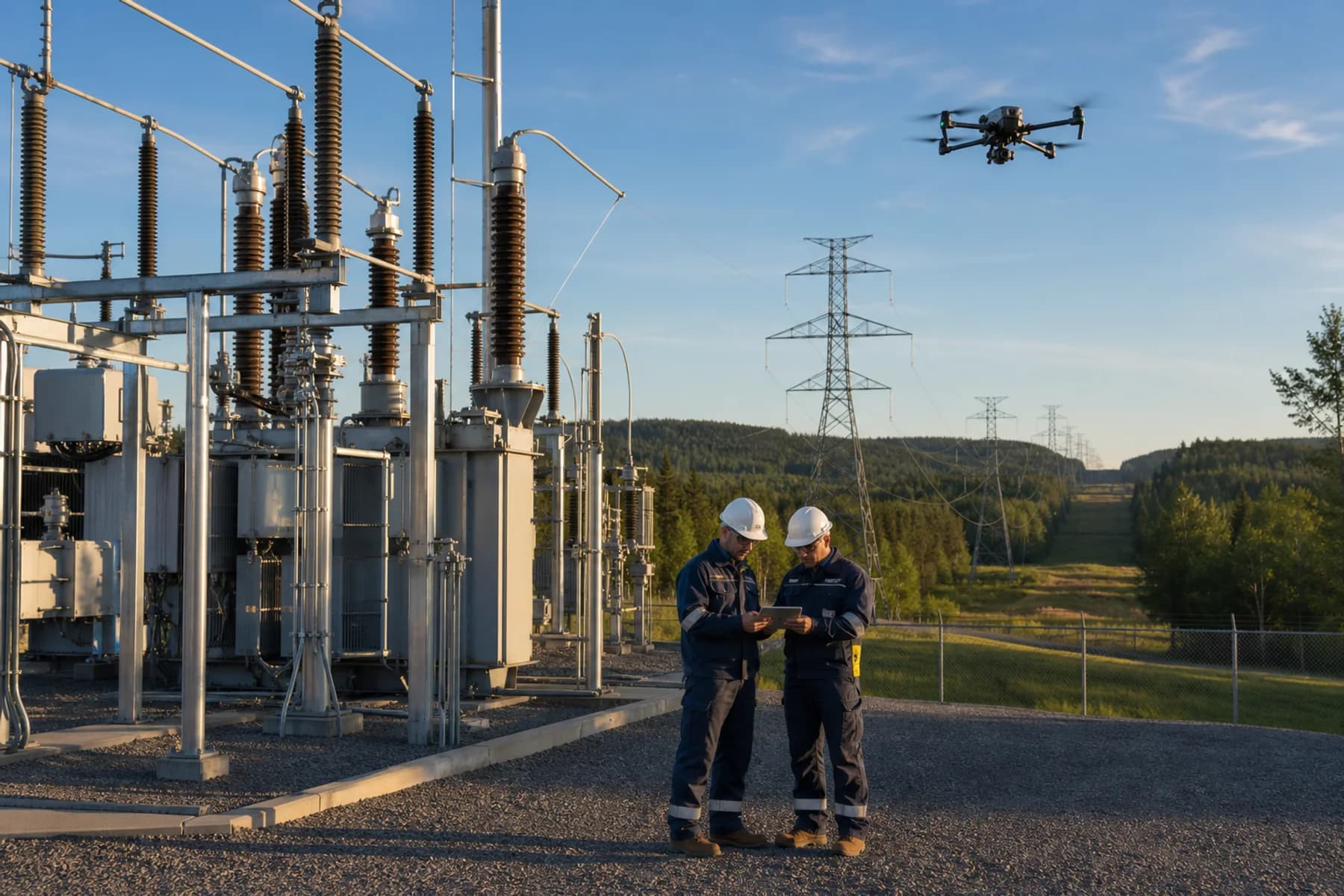
Substations and overhead lines combine dense equipment, large geographic coverage, high-consequence failure modes, and strict operating controls. A useful drone program must therefore do more than collect attractive imagery: it must respect exclusion zones, preserve asset traceability, and produce evidence that planners can translate into approved maintenance scopes.
High-resolution RGB and radiometric thermal payloads complement established utility inspection practices. They can improve coverage and reduce unnecessary exposure, while qualified engineers remain responsible for interpreting findings, applying system context, and determining the correct intervention.
One program, two very different inspection environments
Inside a substation, the inspection model is asset-dense. Transformers, bushings, radiators, terminations, connectors, bus joints, arresters, insulators, switchgear exteriors, structures, fencing, and civil assets require controlled viewpoints and accurate naming. Along a line corridor, the model becomes linear: towers or poles, circuits, spans, insulator strings, conductors, spacers, foundations, access routes, and vegetation must remain correctly sequenced.
The data structure should reflect those differences. A substation finding may be linked to a bay and equipment position; a line finding should reference circuit, structure, side, phase, component, and span where appropriate.
Capture thermal and visual evidence safely
Radiometric thermal capture can surface unusual heating at connectors, terminations, bus joints, bushings, or other accessible external components. Interpretation should consider load, phase comparison, ambient conditions, emissivity limitations, reflections, viewing angle, and the operating history of the asset.
RGB imagery supports assessment of corrosion, contamination, oil-leak indicators, damaged hardware, cracked or missing components, foundation condition, drainage, erosion, and vegetation clearance. These observations are indicators for review—not autonomous final diagnoses.
- Use approved safe-standoff positions and maintain visual line of sight.
- Keep drones clear of conductors, buswork, structures, and switching operations.
- Coordinate with the control room and site safety authority before and during capture.
Turn observations into a maintenance hierarchy
ML/DL analysis can help surface repeated visual or thermal patterns across large datasets and group similar findings for review. The engineering workflow then evaluates operational significance, confidence, access requirements, outage dependency, and the consequence of deferral.
A practical register distinguishes urgent investigation, planned outage work, approved live-line or specialized work, cleaning priorities, vegetation activity, civil repair, and condition monitoring. Supporting images, thermal files, GPS location, and asset references should travel with each item.
Verify maintenance and preserve condition history
Targeted recapture after approved cleaning, tightening, replacement, vegetation work, or civil repair provides objective closeout evidence. Comparable viewpoints also help teams determine whether corrosion, contamination, or structural concerns are stable or progressing.
Over time, the inspection record becomes more valuable than any single flight. It supports outage planning, contractor scoping, recurring-condition analysis, and risk-based budgeting across substations and line corridors.
Operational perspectiveThe strongest grid-drone programs combine disciplined aviation, utility safety controls, asset-level traceability, and engineering review. Coverage is only useful when it leads to a controlled maintenance decision.